Showing posts with label West Brom. Show all posts

Friday, 28 February 2014

Goal decision system: how things could have been different.

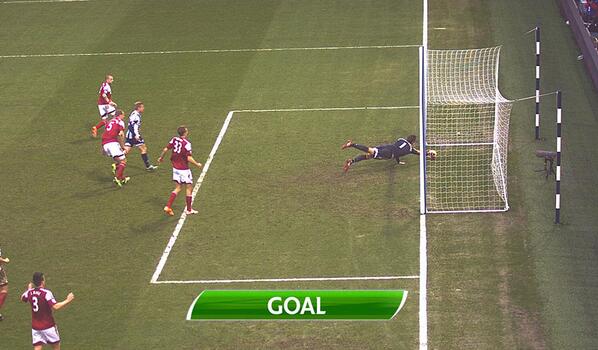
Matej Vydra scored late on against Fulham on Saturday to earn a point for West Brom in what many feel condemned Fulham to relegation. The goal was awarded following use of the goal decision system, one of the closest decisions made since the technology's incision this season.
Goal Decision System confirms crucial late equaliser
for West Brom (veooz.com)
It is a goal that were the wrong decision made, the outcome of the relegation zone could be completely different. Not only do they immediately effect the table they consequently effect; player confidence, form, managerial security, potential for different tactics to be used in other games in the season. What is effected by these decisions are exponential.

Lampard versus Germany (bbc.co.uk)


It was Frank Lampard's disallowed goal against Germany in South Africa 2010 World Cup Last 16 match that sparked Sepp Blatter's technology lagged brain in to finally exploring the simple necessity of goal line technology. Lampard's goal would have levelled the match and England would have gone on to win their second World Cup - only a goal of such high profile catalysed  the development of goal line technology.


It was 5 years previous that Lampard was on the wrong end of another goal line decision. Luis Garcia's "ghost goal" knocked Chelsea out of Champions League at the Semi Final stage in 2005. Following this incident and Sky's animation (right) proving the goal not to have crossed the line the goal line technology debate has been at the forefront of football fans' discussion. 

Apart from these two high profile incidents the Premier League has witnessed many a potentially season changing goal/save. So how might Premier League seasons have turned out differently had Goal Line technology been implemented earlier? Here are a few other incidents that goal line would have easily cleared up.


Clint Hill vs Bolton (March 2012):


Clint Hill's disallowed goal v Bolton (dailymail.co.uk)
On 10th March 2012, QPR and Bolton were the televised kick off in a game being dubbed as must win for both, Hill looked to have scored from a header with the score at 0-0 but the goal wasn't given. Replays showed the ball had clearly crossed the line. Bolton went on to win 2-1 and leapfrog QPR in to 17th place leaving Rangers in the relegation places. As it turned out QPR stayed up and Bolton were relegated that season.


Pedro Mendes v Man United (January 2005):


This may be the most blatant goal never to be given. The game finished 0-0 just keeping United's title challenge possible. The incident gave weight to the Garcia ghost goal in the argument for technology to be introduced in football. It probably didn't have a big effect on the final standings that season with United well off the pace of Chelsea and Spurs finishing in a lacklustre top half position.


Frank Lampard v Spurs (April 2011):


Similar to how Andy Gray describes Liverpool's fortuitous goal in the Champions League, it could be said 'what goes around comes around' for Lampard. His 40-yard strike didn't cross the line but was given by the referee. It was given almost under the same terms as umpires in Cricket would give a batsman out LBW if he had played a poor shot, Gomes' blunder did not help his or Spurs' cause here. The game ended 2-1 to Chelsea, keeping alive their title hopes and all but ending a potential second successive season in the Champions League for Spurs. Chelsea didn't have enough to win the league and Spurs ended six points adrift of 4th place.

Hypothetical outcomes aside, football fans can now be thankful for the success of goal line technology but some will feel it should have arrived a lot sooner and they will still always wonder: what if? 

Sunday, 23 February 2014

Sam Allardyce: proof "new manager syndrome" is not the only option for club owners

West Ham moved to 10th in the Premier League, seven points clear of the drop after their fourth straight victory in the league. Sam Allardyce finds himself in a position of stark contrast to that of two months ago. Some people are calling for him to win a Manager of the Month award for February for which he has instantly and quite comically dismissed. A lot of credit must go to the West Ham hierarchy, David Gold and David Sullivan, who stuck by Allardyce when it mattered. They insisted he was the right man to keep the Hammers' up and their faith has been well and truly repaid; a prime example of why club owners are naive to expect a 'new manager syndrome' will always get instant results and revitalise a season.

That is not to say there is some substance to the 'new manager syndrome' invigorating the squad and improving the team in the short term, but in the long term no club, with the exception of Crystal Palace and possibly Sunderland, which has sacked a manager in the Premier League this season are in a indisputable better position. Additionally it is only Palace who have appointed a manager, proven in the Premier League. Tottenham are a slight red herring as their aims do not involve survival and are completely different to the other sides, as are Sunderland who are definitely better off with Gus Poyet at the helm, but their rash sacking of Steve Bruce, currently flourishing at Hull, was the catalyst to their early season capitulation under Di Canio. Although Sunderland are still in danger of going down, and Spurs are still struggling to capitalise on Manchester United's shortcomings this season and look set to miss out on Champions League again. Palace, after their appointment of Tony Pulis, have been the only clear beneficiaries of the manager merry-go-round.
Graphic: How teams who have sacked managers have fared?
West Brom, Swansea, Fulham and Cardiff all hoped their managerial changes would be as successful as Crystal Palace's or even Sunderland's but this has not been the case. Fulham have had a nightmare season, on and off the pitch with both aspects effecting one another to highly detrimental levels; Rene Meulensteen who replaced Martin Jol has since been replaced himself just 14 weeks later by Felix Magath - it remains to be seen if he can keep Fulham up. Ole Gunnar Solskjaer has replaced Malky Mackay and in two months in charge Cardiff's relegation prospects have increased dramatically. Both Pepe Mel of West Brom and Gary Monk of Swansea have taken over from managers who were sacked unexpectedly with their team in not an awful lot of immediate danger and very much expected to survive the drop but are currently just one and three points above the drop respectively and will be eagerly looking over their shoulders at the teams below them.

Despite Crystal Palace, Sunderland and Tottenham Hotspur's positional improvements of three, two and two places respectively it is West Ham who, after deciding to keep Sam Allardyce, will feel most content with their managerial decisions boasting a great improvement in results jumping from 19th to 10th since the board publicly backed him on January 6th. Ironically a public backing is often known as a dreaded 'vote of confidence' which ultimately result in a managers sacking just days later. It seems, with safety in sight West Ham are an example for many other struggling clubs to follow.